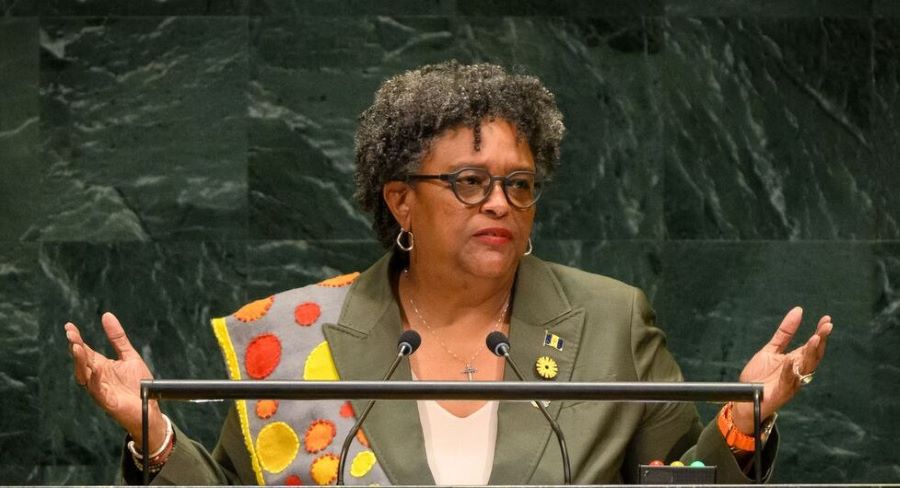
Prime Minister Mia Amor Mottley of Barbados has developed a rare quality in international diplomacy. She can speak with the moral urgency of an advocate, the precision of a lawyer and the pragmatism of a head of government, often within the same address.
The excerpt of her speech at the United Nations earlier today (September 24, 2026) featured in the accompanying video below is another example of a style that has become increasingly familiar on the international stage. Mottley asks nations to confront uncomfortable history, but she does so without making history a prison from which present generations cannot escape. She uses it instead as evidence, a record of human choices whose successes and failures should inform the choices being made today.
That distinction matters. Mottley has repeatedly returned to a simple proposition throughout her years in office: a world governed primarily by power will inevitably disadvantage countries that possess little of it. Small states therefore have a profound interest in international law, functioning multilateral institutions, equitable access to finance and rules that apply with reasonable consistency to powerful and vulnerable nations alike.
This is not a theme Mottley discovered recently. As early as her 2018 address at the Global Climate Action Summit, shortly after becoming Prime Minister, she argued that the physical survival of Caribbean island states was threatened by climate change.
At the United Nations in 2019, she spoke of the need for “fairness, equity” and an international order capable of accommodating the different circumstances of nations. She also argued that multilateralism provides small states with protection against the unrestricted exercise of power by larger countries. That argument has matured rather than disappeared.
From Climate Vulnerability to Global Equity
Mottley’s speeches over the years reveal remarkable thematic consistency. Climate change, debt, development finance, inequality, colonial history, institutional reform and the vulnerability of small states might initially appear to be separate subjects. In Mottley’s international advocacy, they form parts of the same argument.
Her contention has been that the international system was largely constructed under political and economic circumstances very different from those confronting developing nations today.
That argument became particularly visible in her advocacy for reform of international development and climate finance through what became known as the Bridgetown Initiative. The initiative sought changes to the global financial architecture so that vulnerable and developing countries could obtain financing on terms better suited to climate shocks and development needs. The United Nations subsequently described the Bridgetown agenda as an effort to make finance work for “people, planet and prosperity.” This is where Mottley has moved beyond rhetoric.
It is relatively easy for political leaders to tell international institutions that the system is unfair. Humanity has accumulated a formidable supply of speeches explaining what is wrong with humanity. The more difficult task is proposing mechanisms through which it might be changed. Mottley has attempted to do that.
Bold Without Abandoning Diplomacy
One of the most interesting characteristics of Mottley’s international speeches is her willingness to challenge powerful countries and institutions without routinely turning those challenges into personal attacks. That is a difficult political balance.
Diplomacy can become so cautious that nothing meaningful is said. Political rhetoric can move in the opposite direction, becoming so confrontational that audiences who might otherwise listen simply retreat to their respective positions. Mottley frequently operates somewhere between those extremes.
At the 2022 United Nations General Assembly, for example, she questioned the structure of the Bretton Woods institutions, challenged the representativeness of the G7 and G20, and called for reform of the Security Council and its veto structure. These were substantial criticisms of institutions dominated by the world’s most powerful states. Yet her broader argument was about inclusion rather than exclusion. That distinction helps explain her effectiveness.
Mottley can criticize the architecture of international power while continuing to engage those who benefit from that architecture. She can demand greater consideration for developing countries without suggesting that cooperation between wealthy and developing nations is either impossible or undesirable.
Her diplomacy therefore seeks something more useful than agreement with her diagnosis. It seeks participation in the remedy.
History Without Permanent Hostility
Another important feature of Mottley’s rhetoric is her use of history. For Caribbean societies, discussions about slavery, colonialism, exploitation and economic inequality can quickly become politically charged. There is no legitimate reason to sanitize that history. Equally, recounting historical injustice without identifying a path forward can leave nations arguing indefinitely over inherited grievances. Mottley’s approach frequently asks a different question. What can history teach us about the institutions we should construct now?
That allows her to discuss colonialism, slavery, racial inequality and economic exploitation while still appealing to countries on different sides of that history to participate in building something better. It is an important diplomatic skill because empathy cannot simply be demanded. It often has to be cultivated.
Effective diplomacy requires a leader to explain the experience of one society in terms that another society can understand without requiring either side to surrender its identity. Mottley has demonstrated an unusual ability to do precisely that.
Her message to wealthy countries is rarely that prosperity itself is objectionable. Her argument is that the international system should provide poorer and vulnerable countries with a realistic opportunity to achieve prosperity themselves.
Her climate argument follows much the same construction. Small island states contributed relatively little to the accumulated greenhouse gases driving climate change, yet they face disproportionately severe consequences. The answer, in her formulation, is not simply assigning blame. It is constructing financial mechanisms that allow vulnerable countries to survive, adapt and develop.
The United Nations itself has recognized the reach of that advocacy. In 2021, Mottley was named a UN Champion of the Earth for Policy Leadership, with the UN Environment Program highlighting her advocacy for vulnerable developing states and climate finance.
A Voice Larger Than Barbados
Mottley became Barbados’ eighth Prime Minister and its first female Prime Minister following the 2018 general election. Her political career, however, stretches back decades. She was first elected to Parliament in 1994 and previously served in portfolios including education, home affairs, economic affairs and as Attorney-General and Deputy Prime Minister. That experience is evident when she speaks internationally.
She does not sound like a leader who suddenly discovered foreign policy after becoming Prime Minister. There is an understanding of institutions, law, economics and political negotiation beneath the rhetoric.
It also helps explain why a country with a population and economic weight that could easily be overlooked in international affairs has acquired such visibility in debates over climate finance and reform of the international financial system.
UN Secretary-General António Guterres has publicly described Barbados as an influential regional leader and praised Mottley’s international advocacy, particularly on climate change, debt, development and the circumstances facing small island developing states.
Her 2025 address to the 80th United Nations General Assembly extended the same philosophy into another increasingly fractured international environment. She addressed overlapping financial, social, geopolitical and climate crises while again questioning whether existing global institutions remain capable of responding effectively. The consistency is important.
Political charisma can command a room. It cannot by itself sustain an international policy agenda. Mottley’s influence has increasingly rested on combining rhetoric with specific proposals.
Leadership From a Small State
Guyana Graphic’s assessment is that Mia Amor Mottley represents one of the most consequential political voices to emerge from the modern Caribbean.
That is an editorial judgment, rather than a measurable fact. Political leadership should ultimately be assessed against domestic outcomes as well as international reputation, and Barbadians themselves will continue to judge her government’s record. But her international contribution can be examined separately.
On that stage, Mottley has demonstrated an unusual combination of charisma, intellectual command, political instinct and diplomatic discipline. More importantly, she has refused to accept the proposition that the size of one’s country should determine the size of one’s voice.
Barbados cannot compel the major powers to change the international financial architecture. It cannot dictate climate policy to the world’s largest economies. It cannot independently restructure the United Nations.
Mottley nevertheless behaves as though Barbados has both the right and responsibility to participate fully in those debates. That may ultimately be one of the most important examples she offers other Caribbean leaders. Small countries need not behave as spectators in the international system.
An Ambassador for the Vulnerable
There is also something broader occurring in Mottley’s diplomacy. When she speaks about climate vulnerability, debt or access to development financing, Barbados frequently becomes a platform for concerns shared by countries thousands of miles beyond the Caribbean.
Pacific island nations threatened by rising seas, African countries confronting debt and development constraints, Caribbean economies repeatedly exposed to hurricanes and other developing states struggling with the cost of capital can recognize elements of their own circumstances in her arguments.
She has consequently become an important advocate for a constituency much larger than Barbados. Her strongest speeches do something particularly difficult. They challenge without automatically alienating. They remind without simply accusing. They demand change while leaving space for those being challenged to become participants in that change. There is firmness, but there is also an invitation. That is diplomacy at its most useful.
The Lesson for the Caribbean
The Caribbean has produced many formidable international figures. Its small population has never prevented the region from contributing disproportionately to diplomacy, literature, economics, law, culture and political thought.
Mottley belongs within that tradition. Her example also offers a lesson for contemporary Caribbean leadership. A small country’s influence does not have to correspond to its population, military strength or gross domestic product. Influence can come from preparation, intellectual credibility, consistency and the ability to articulate an argument that other countries recognize as relevant to their own circumstances.
The speech featured here demonstrates that principle again. Mottley is prepared to confront the failures of the international system, but she does not appear interested in destroying international cooperation. She wants that cooperation to work better.
She invokes history, but her destination is the future. She speaks for Barbados, yet deliberately broadens the conversation to include countries and peoples whose economic and political influence often leaves them unheard.
And perhaps that explains much of her international appeal. Mia Mottley does not ask the world to forget its history. She asks it to understand that history well enough to avoid repeating its failures.
For a world again confronting war, inequality, climate disruption, economic uncertainty and growing distrust of international institutions, that is a message worth examining, regardless of one’s political perspective.
The measure of leadership is ultimately found not in applause following a speech, but in whether ideas survive after the room has emptied.
Mia Amor Mottley’s ideas have increasingly entered the international conversation. For Barbados, for the Caribbean and for developing societies seeking a meaningful voice in determining the rules under which they must live, that alone is significant.