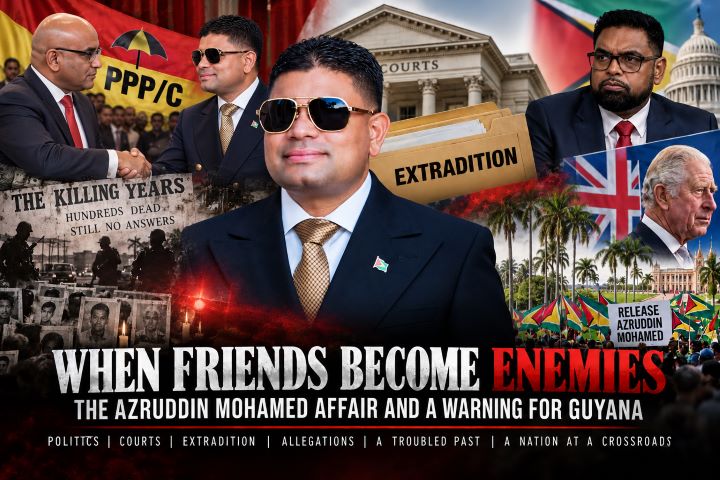
Something is going wrong in Guyana, and it’s bigger than Azruddin Mohamed. It’s bigger than the PPP/C, and bigger even than the bitter fight between the government and the man who now holds the constitutional office of Leader of the Opposition. The real question is whether the State’s machinery, meaning its police, intelligence services, prosecutors and extradition process, can be turned on a political opponent without destroying the public confidence a democracy depends on.
Mohamed gets no special immunity because he leads the Opposition. If there is credible evidence that he committed crimes, he should answer for it before an independent court. But the reverse holds too. Being Opposition Leader doesn’t make a citizen any less entitled to due process, the presumption of innocence and equal protection under the law. That distinction matters more with each passing week.
The American case
The U.S. case against Azruddin Mohamed and his father, Nazar, is real and serious. In June 2024, the Treasury Department’s Office of Foreign Assets Control sanctioned the Mohameds, Mohamed’s Enterprise and related businesses under the Global Magnitsky regime, alleging corruption in Guyana’s gold sector and ties to Guyanese officials. A U.S. federal grand jury later indicted both men. Prosecutors allege a scheme involving gold exports, money laundering, and fraud, in which roughly US$50 million in Guyanese taxes and royalties were avoided. The indictment also alleges that Azruddin evaded more than US$1 million in taxes on the import of a Lamborghini.
These are allegations. The Department of Justice itself says an indictment is only an allegation and that defendants are presumed innocent until proven guilty beyond a reasonable doubt. Guyana would do well to remember that sentence. An American indictment gives the Guyanese government no license to treat Mohamed as already convicted.
Extradition is a legal process, not a political shortcut
The government received the American extradition request on October 30, 2025, and the Minister of Home Affairs then issued an Authority to Proceed under the Fugitive Offenders Act. Those who argue that Guyanese citizenship alone blocks extradition have an uncomfortable fact to face: it doesn’t. Guyana’s framework allows it to extradite its own nationals, and an international evaluation of the country’s laws found no prohibition on doing so. The law requires dual criminality and includes protections against politically motivated extradition.
The Mohameds fought the process. Among other arguments, they said the Authority to Proceed was tainted by political bias, pointing to statements senior officials made during the election campaign. So far, the courts have largely rejected them. The Court of Appeal dismissed one challenge, and on July 29, 2026, the Caribbean Court of Justice unanimously dismissed their appeal and let the proceedings continue.
Those rulings matter. You can’t praise the courts when they rule your way and dismiss them when they don’t. But approving the extradition process doesn’t settle every question about how the government has treated a political opponent more broadly, and that’s where this affair gets disturbing.
From extradition to national security
During the extradition hearings, Senior Superintendent Prem Narine, who heads the police Special Branch, reportedly testified that intelligence led him to regard Mohamed as a threat to society and national security. Things escalated from there. In September, prosecutors raised in court the possibility of treason, an attempted coup and even an assassination plot. They offered no evidence that Mohamed had committed any such offense, and the Chief Magistrate declined to revoke his bail.
Consider what was just said about the country’s chief opposition figure: assassination, coup, treason. Few words are more explosive for a State to attach to an Opposition Leader. Once spoken in public, they take on a political life of their own, whether or not charges ever follow. That puts a heavy responsibility on the State. Intelligence is not evidence, and suspicion is not proof. Circumstantial evidence can support a prosecution, but it must eventually be tested. Intelligence reports can’t become a parallel justice system in which accusations are repeated until repetition passes for proof.
The October incident
The situation grew more serious on October 12. Police say a vehicle carrying Mohamed and two other men passed Narine’s home, that Narine heard what sounded like a gunshot, and that he fired several rounds toward the vehicle. Police arrested Mohamed and the others and say they recovered an unlicensed .32-caliber firearm and ammunition. Mohamed and his co-accused pleaded not guilty and were granted bail.
Then came the surveillance footage. Mohamed released video he apparently believed supported his account. Police later alleged that a constable had improperly downloaded it and received GY$800,000 from Mohamed in return. On October 30, Mohamed and Police Constable Ryan Greene were refused bail and remanded on charges tied to the alleged disclosure of surveillance recordings and bribery.
Those allegations deserve investigation. But they are still allegations, not convictions. And when the accused is the constitutionally recognized Leader of the Opposition, transparency matters more, not less.
King Charles and an awkward coincidence
Mohamed’s detention overlapped with King Charles III’s visit to Guyana on October 29 and 30. Before the visit, WIN MP Gobin Harbhajan publicly called for the Opposition Leader to be included in the King’s program. The published itinerary apparently had no meeting between the King and Mohamed, so it would be overreach to claim he was arrested to prevent one that was already scheduled.
Still, the optics are hard to ignore. The country’s main opposition leader sat in custody during a royal visit while his supporters demonstrated near State House demanding his release. Democracies should care about appearances, because public confidence in institutions depends partly on citizens believing that police powers aren’t exercised for political convenience.
The former friend
There’s another piece of this story Guyana can’t skip. Azruddin Mohamed was not always an enemy of the PPP. He has said publicly that his family financially supported the PPP/C before it returned to government in 2020, contributing hundreds of millions of Guyana dollars, perhaps billions. Whatever the exact figure, the relationship is significant. The man who now leads the Opposition was once associated with the movement that confronts him in courtrooms, police stations and Parliament. Any politically connected businessman in Guyana should look at that journey and think hard, because Guyana has been down dangerous roads before.
The unfinished business of the killing years
The country still carries unresolved wounds from the wave of violence that began around 2002. The historical record needs careful handling, because allegations from that period have too often hardened into partisan folklore. But the violence itself was real.
A United Nations independent expert recorded concerns about numerous killings of young Afro-Guyanese men and reports of a so-called “phantom death squad,” and people the expert interviewed put the death toll between 200 and 400. A study published through the UK government’s development research system called it the bloodiest phase of post-independence Guyana and discussed allegations involving phantom squads, criminal organizations, security agencies and political connections. Human-rights reporting at the time documented claims of death squads that included serving and former police officers. Phone records allegedly linked people tied to those groups to then-Home Affairs Minister Ronald Gajraj, and a presidential commission later examined parts of the controversy. The U.S. State Department, for its part, was still reporting concerns about possibly unlawful police killings and other serious abuses during these years.
Much of this remains disputed. What can’t reasonably be disputed is that Guyana went through a period of killings, criminal violence, allegations of politically connected armed groups and deep institutional failure, and that too many families never got satisfactory answers. The history matters now for one reason above all: a democracy can’t let political, business and security relationships, along with criminal allegations, become so tangled that no one can tell where the State ends, and private power begins.
A cautionary tale for political financiers
When businessmen fund politicians because they expect access, contracts, protection or influence in return, they aren’t strengthening democracy. They’re building dependencies, and dependencies last only as long as interests line up. Today’s financier can become tomorrow’s liability. Today’s political friend can end up as tomorrow’s witness, today’s protected businessman as tomorrow’s target, and today’s intelligence partner as tomorrow’s “national security threat. That’s why Guyana urgently needs modern campaign-finance laws that require disclosure of large political donations. Mohamed, after acknowledging his family’s past support for the PPP/C, himself called for greater transparency. There’s plenty of irony in that, but irony doesn’t make the proposal wrong. Guyanese deserve to know who finances their politicians.
Washington should be careful too
The United States has its own reasons to tread carefully. Guyana matters strategically to Washington because of oil, regional security, Venezuela, migration, narcotics trafficking and China’s growing presence in the Caribbean. That importance makes reliable intelligence essential, so anything a Guyanese government tells the U.S. about its domestic opponents should be independently corroborated. This holds whether the PPP, the PNC or WIN is in power. No foreign government should unknowingly become a tool in someone else’s domestic fight.
At the same time, it would be irresponsible to suggest the U.S. case exists simply because Georgetown wanted Mohamed gone. The investigation involved Homeland Security Investigations, IRS Criminal Investigation, the State Department’s Diplomatic Security Service, Customs and Border Protection, federal prosecutors and a federal grand jury. Those facts can’t be wished away. But Guyana shouldn’t outsource its political conflicts to Washington either.
Let the evidence speak
Much of this has a simple answer: evidence. If Mohamed took part in money laundering, prove it. If he evaded taxes, bribed public officials or illegally possessed a firearm, prove it. If he bribed a constable for government surveillance footage, or tried to intimidate a witness, prove that too. And if anyone seriously intends to allege that the Leader of the Opposition plotted an assassination, treason or a coup, the evidence had better match the gravity of the accusation. File the charges, put the witnesses under oath, allow cross-examination, and let independent judges decide. That is what separates constitutional government from political persecution.
The same standard applies to Mohamed. If he has evidence that police, government officials, or political actors tried to frame, intimidate, harass, or harm him, he should produce it and let it face the same scrutiny. No politician deserves conviction by press conference, and no government deserves conviction by allegation.
Guyana is bigger than the PPP and WIN
In the end, this isn’t a defense of Azruddin Mohamed. It’s a defense of institutions. He may be convicted. He may be extradited. He may beat the allegations. Those outcomes belong to courts applying the law to evidence.
What Guyanese should resist is something more dangerous: the normalization of State institutions as extensions of whichever party occupies Freedom House and the Office of the President. PPP supporters should care about that principle even if they despise Mohamed. WIN supporters should care even if they’re convinced every charge against their leader is invented. PNC supporters should remember their own history with the State. Governments change, friendships change, business alliances change, and power changes hands. Every extraordinary power we accept because it’s used against someone we dislike becomes a precedent we can use tomorrow against someone we support.
Mohamed’s journey from financial backer of the PPP to its chief parliamentary opponent may become one of the most important cautionary tales in modern Guyanese politics. Patronage buys no permanent friendships, money buys no lasting protection, and access guarantees no loyalty. Closeness to power turns dangerous fast when yesterday’s friend becomes tomorrow’s rival. Guyana should have learned that lesson already. Its history has been expensive enough.