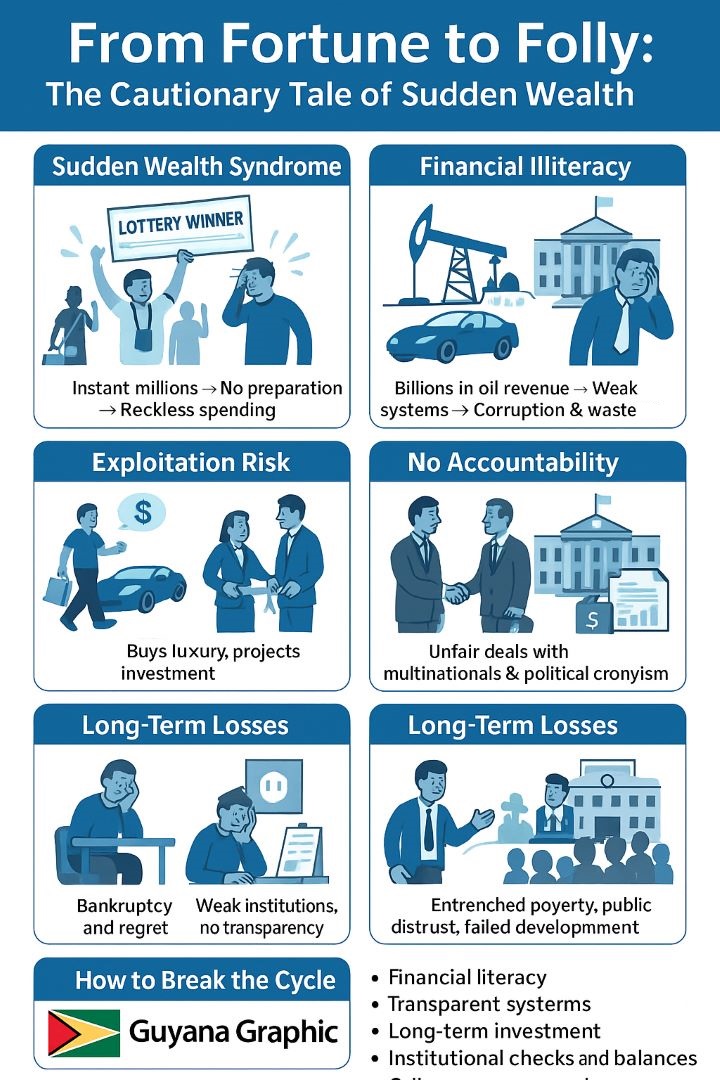
When we hear of someone winning the lottery, our minds leap to dreams fulfilled, mansions, exotic travel, and the end of financial worries. Similarly, when a nation discovers oil, the assumption is that it’s finally on the road to prosperity. But history tells us a darker, cautionary tale: that sudden wealth, in the hands of the unprepared or corrupt, often becomes a curse.
There’s a haunting parallel between the private individual who wins the lottery and the government that strikes oil. Both are gifted with unimaginable financial resources, and both more often than not fail to sustain them.
Sudden Wealth, Zero Preparedness
A lottery winner may go from living paycheck to paycheck to having millions. With no training in finance or investment, they make impulsive purchases, attract opportunists, and often end up bankrupt within a few years.
Now replace the individual with a government. Oil revenues flood national coffers. But instead of long-term investments in education, healthcare, and diversification, spending is funnelled into showy projects, inflated contracts, and politically connected pockets. The poor remain poor. The rich get richer. The country stagnates sometimes even regresses.
Exploitation is Inevitable
Lottery winners are preyed upon by financial predators. They receive bad advice, fall into scams, and lend or gift their fortune away without accountability.
Governments face the same except the stakes are much higher. Multinational oil firms, lobbyists, and foreign governments all seek a slice. In countries lacking transparency and oversight, contracts are negotiated in secret, bribes are paid in back rooms, and entire economies are mortgaged for short-term gains.
No Systems, No Sustainability
Wealth does not equate to wisdom. In both scenarios, the real tragedy is the absence of sound systems. A windfall without planning is like rainfall on concrete—it doesn’t nourish, it just runs off.
While the lottery loser eventually fades into anonymity, a government’s failure leaves scars on generations: broken infrastructure, hollow institutions, disillusioned citizens, and squandered opportunity.
The Path Forward
The lesson here isn’t anti-wealth it’s pro-wisdom. Sudden riches require even greater discipline, vision, and accountability. For oil-rich nations, especially those like Guyana, the priority must be building transparent governance structures, professionalizing public finance, and shielding institutions from political interference.
Otherwise, the oil boom will become a boom-and-bust tragedy. Like the lottery winner who ends up worse off than before, so too will the nation that fails to turn its blessing into a sustainable legacy.
Comparison: The Lottery Winner vs. The Oil-Rich Government
1. Sudden Wealth Syndrome
Lottery Winner:
-
Overnight wealth leads to poor financial decisions.
-
No preparation, structure, or plan to manage the windfall.
-
Friends, family, and opportunists quickly gather, leading to reckless spending and dependency.
Oil-Rich Government:
-
Discovery of oil wealth brings in billions without systemic readiness.
-
Lacking institutional safeguards and transparency, funds are often misused or misallocated.
-
Political elites and cronies exploit access for personal gain rather than national development.
Similarity: Both receive a windfall without the mechanisms or mindset to manage it sustainably.
2. Lack of Financial Literacy and Foresight
Lottery Winner:
-
Often lacks education or experience in investment, budgeting, or wealth preservation.
-
Many believe the money is endless and make extravagant purchases or risky investments.
Oil-Rich Government:
-
Officials may lack technical expertise or the political will to invest in long-term infrastructure, education, or healthcare.
-
Focus is often on short-term projects that offer political optics or kickbacks.
Similarity: Wealth is treated as a tap that will never run dry until it does.
3. Vulnerability to Exploitation
Lottery Winner:
-
Becomes a target for scammers, bad financial advisors, and predatory lenders.
-
May fund the lifestyles of others, draining their wealth without building assets.
Oil-Rich Government:
-
Attracts multinational corporations and foreign interests that negotiate unfair contracts.
-
Local leaders may cut deals for personal benefit, undermining national interest.
Similarity: External actors exploit both due to naivety, greed, or lack of oversight.
4. Absence of Accountability
Lottery Winner:
-
No accountability mechanism; decisions are personal and unregulated.
-
By the time they realize the money is gone, it’s too late to recover.
Oil-Rich Government:
-
Often lacks independent oversight bodies, freedom of the press, or strong civil institutions.
-
Corruption flourishes under opacity; funds vanish with little to show for them.
Difference: While the lottery loss affects one individual or family, government mismanagement harms entire nations and generations.
5. Short-Term Gratification vs. Long-Term Planning
Lottery Winner:
-
Prioritizes flashy homes, cars, and lavish lifestyles.
-
Rarely sets up wealth-generating assets like businesses or trusts.
Oil-Rich Government:
-
Focuses on ribbon-cutting projects, political patronage, and immediate political gains.
-
Neglects sustainable investments like education, technology, or diversified economies.
Difference: The government’s failure can entrench poverty and political instability long after the oil runs out.
Conclusion: A Cautionary Tale of Irresponsible Wealth
Both the lottery winner and the oil-rich but corrupt government fall victim to the illusion that wealth is infinite. They squander their windfalls due to greed, ignorance, a lack of planning, and a lack of accountability.
However, the consequences of government mismanagement are far more devastating: entire populations suffer, economic dependency deepens, and the promise of prosperity becomes a curse.
In both cases, it is systems, not money, that sustain wealth. Without vision, discipline, and governance, even the most excellent fortune becomes a fleeting illusion.