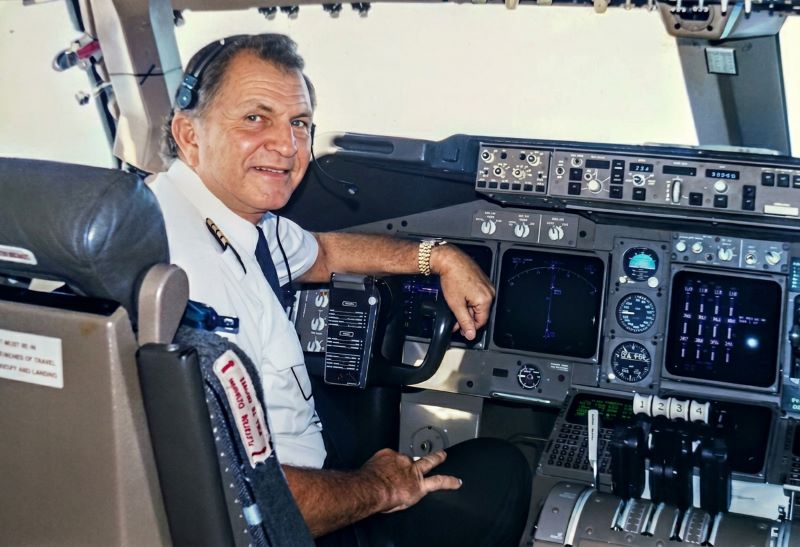
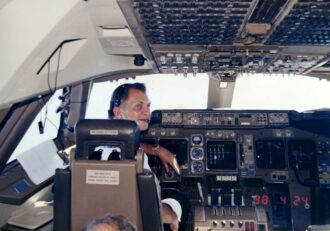
Before he could walk, Michael Pacheco looked up at the sky and saw something that would define the rest of his life, a glowing silver blimp drifting silently overhead. That infant memory, vivid and otherworldly, planted a seed in a boy born in 1941 who would grow up to become one of the trailblazing aviators the Caribbean has ever produced.
His story is one of relentless curiosity, extraordinary courage, and a series of firsts that left permanent marks on the history of aviation.
A BOY FROM BRITISH GUIANA.
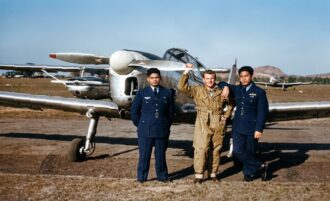
Michael grew up an only child in British Guiana, the nation that would come to be known as Guyana.
His mother was a devoted and resourceful woman who dedicated her life to ensuring he had every opportunity to succeed.
She worked at the Singer Sewing Machine Company in Georgetown, where she was the head Seamstress. This found her traveling the interior, visiting Amerindian settlements, and teaching them to sew. Her commitment to her craft and community ran deep.
Michael’s early years were vivid with the kind of boyhood that seems borrowed from adventure fiction. He laughed heartily at his very first movie, a Laurel and Hardy comedy, at just two years old. He swam in wild canals and even across the Demerara River at Georgetown. He once pushed his scooter 25 miles to be part of a Religious gathering.
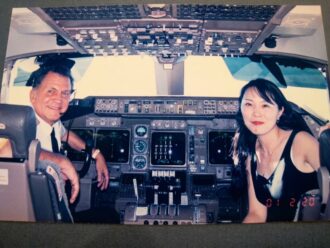
By his own account, he dreamt of being a pilot, a priest, or perhaps both.
He attended Ursuline Convent for Kindergarten, ferried daily by his mother on her bicycle.
By age eight and a half, he was enrolled at St. Stanislaus College, where a happy coincidence awaited him: two classmates, Ed Driver and Roger King, shared his birthday. The three became close friends well into their twenties. Roger has since passed on, but Ed Driver and Michael remain friends to this day.
SCOUTING AND BROTHERHOOD
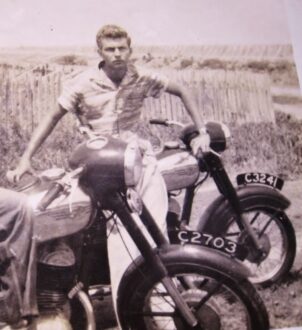
Michael was a proud member of Scout Troup 39, where he forged bonds and developed the leadership instincts that would serve him for a lifetime. It was through scouting and the wider circle of friends it brought that he met Louis Chung, his first Chinese friend, and together with others, they spent countless days camping and riding motorcycles into the Guyanese wilderness.
One expedition stood out above the rest. Michael and his close friend Richard Texeira pioneered a night motorcycle journey from Georgetown to Mackenzie, pushing through swamps, dense forest, and darkness with no established road to guide them. The trail they blazed that night would eventually become a main road.
THE SPARK OF AVIATION
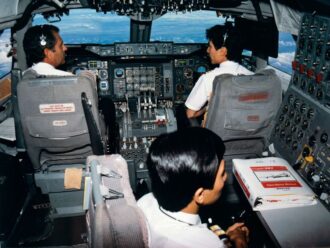
Even before he ever sat in a cockpit, Michael had a gift for all things mechanical and airborne.
As a young man, he built radios capable of receiving aircraft frequencies. He monitored their whereabouts. On one occasion, he intercepted an incoming transmission and relayed it to the local seaplane base before the operators even knew it was incoming, leaving the staff genuinely astonished.
After college, Michael took a position at the Hand In Hand Mutual Fire Insurance Company in Georgetown, where fate placed him beside two influential figures: aviation icons Henry Fitt and Noel Foster. Noel took him on his very first flight, and something irrevocable clicked into place. Michael spent the following months at Ogle Airstrip, immersing himself in aircraft maintenance. He, together with Henry Fitt, Terry Mc Watt, and Anthony ‘Bungle’ Clavier, rebuilt a Cessna 140 and a Republic Seabee amphibious aircraft.
TRAINING AND TAKING FLIGHT
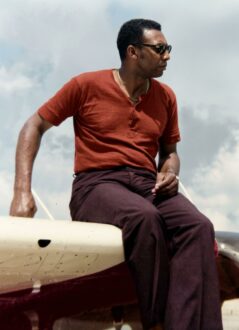
Michael joined the Demerara Light Aeroplane Club at Atkinson field, training under Alec Phillips, a former RAF pilot.
With nearly 100 hours in his logbook, he was awarded a Government Scholarship and departed for Scotland in 1961 to train with Airwork Services, one of just 10 Guyanese selected for the program.
Upon returning home, he flew for British Guiana Airways on the DC-3 and the Grumman Goose, gaining experience on routes across the region.
In 1964, with a pilot shortage emerging in the Caribbean, he was seconded to BWIA in Trinidad, a posting that would launch the next great chapter of his career
CLIMBING THE RANKS AT BWIA
In 1969, at just 28 years old, Michael Pacheco became the first Guyanese Pilot to hold the rank of Captain on a Jet aircraft, the Boeing 727.
It was a milestone that resonated far beyond personal achievement; it was a signal to an entire generation of young Guyanese that the highest altitudes of aviation were within reach.
Beyond the cockpit, he served as Chief Flying Instructor and Civil Aviation Examiner for the Private Pilot’s Licence at the Trinidad and Tobago Light Aeroplane Club.
He also built the first gyrocopter in Trinidad, characteristically turning his off-hours into another frontier to explore.
THE DAY TWO ENGINES WENT SILENT
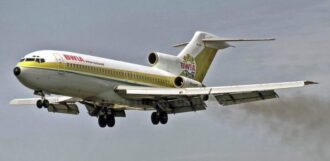
On September 2, 1970, Michael was at the controls of a BWIA Boeing 727 on a flight from Antigua to New York when two of the aircraft’s three engines failed mid-flight.
He diverted to Puerto Rico and made a safe landing.
Two days later, ferrying the aircraft to Miami without passengers, he faced the same crisis again, this time with the third engine failing and the aircraft critically low on fuel.
His contingency plan, if the engine failed entirely, was to ditch the aircraft in the waters off Andros Island in the Bahamas.
Years of flying the Grumman Goose, a seaplane across Guyana’s rivers and coastlines, had given him a confidence in water landings that few commercial pilots possessed. That experience, it turned out, was no mere footnote in his logbook.
He landed safely in Miami.
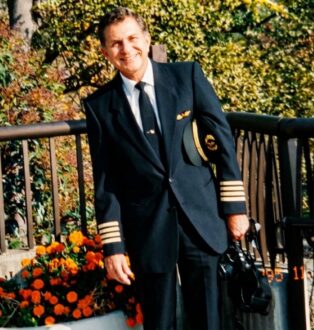
When engineers and the Federal Aviation Administration representatives inspected the aircraft, they found only 1 pint of oil remaining in the only operating engine.
Boeing confirmed it was the first recorded dual-engine failure occurring in 2 days in the 727’s history.
AN ASTRONAUT ON THE FLIGHT
In 1976, he was asked to evaluate a DC-9 aircraft sent to Trinidad by the McDonnell Douglas Aircraft Company. BWIA was interested in expanding its fleet. Pete Conrad, Astronaut and Apollo 12 moonwalker, was his co-pilot for the evaluation flight back to Miami. He came to Trinidad to help demonstrate the aircraft. Pete was also a Vice President of McDonnell Douglas and took the opportunity to check him on the route through Curacao to Miami. It was a career highlight that placed him shoulder- to-shoulder with one of NASA’s most celebrated figures.
SINGAPORE AIRLINES AND THE JUMBO JET ERA
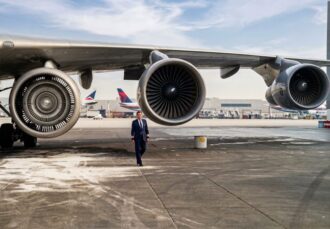
Following a BWIA strike in 1978, Michael joined Singapore Airlines, where he was promoted to Flight Instructor on the Boeing 707.
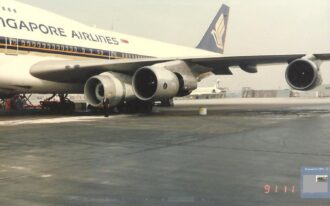
By 1979, he had transitioned to the Boeing 747 as Captain, becoming the first Guyanese and Trinidadian ever to command the iconic jumbo jet. Over the course of his career with SIA, he logged an extraordinary 15,097 hours on the 747 across the -200, -300, and -400 series variants.
In 1984, Michael co-founded Hawaii International Helicopters in Honolulu, offering flight instruction and aerial tours to visitors, many of them Japanese tourists discovering the islands from above.
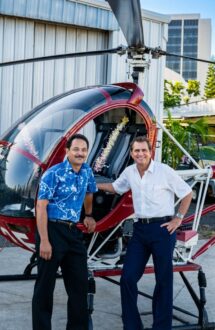
By 1986, he added a helicopter to his credentials, flying the Robinson R22 in California.
FAILURE OVER LOS ANGELES
In 1991, four seconds after takeoff from Los Angeles International Airport on a fully loaded 747 bound for Tokyo, Michael’s number four engine suffered an uncontained explosion. The cascade of failures that followed would have overwhelmed a lesser pilot.
With limited rudder control and mounting emergencies, he dumped 75,000 kilograms (23,000 gallons) of fuel over the Pacific and returned safely to Los Angeles for a landing.
Singapore Airlines later incorporated the incident into Simulator training as a case study in best emergency handling in that scenario.
It stands as a quiet but enduring testament to his skill and composure under pressure.
FAMILY
Michael has 3 children, two daughters and a son.
His son, born in Singapore, has followed his father’s flight path in remarkable fashion.
He is now a Boeing 787 Captain at Etihad Airways, with experience on the Airbus A320, A330, and A340 series, and previous service with Tobago Express and DAC Aviation in Africa on behalf of the United Nations World Food Program.
THE CALYPSO FLYER
Aviation was not Michael’s only element. In 1998, he helped design and launch a custom-built yacht in New Zealand, the Calypso Flyer. Sailing along the Great Barrier Reef off the East Coast of Australia, stopping in towns and cities from Sydney to Cairns, the vessel became a vehicle for a different kind of adventure.
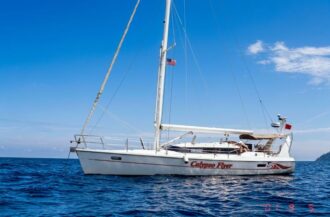
In 2002, Michael and his wife set sail on a five-year circumnavigation of the globe, a voyage that may have well been a first for any Guyanese.
Their route from Singapore to Trinidad carried them across the Bay of Bengal, the Indian Ocean, the Red Sea, through the Suez Canal, along the Mediterranean, and finally across the Atlantic.
The Calypso Flyer rests in Trinidad today, and Michael, though long retired, remains a seafarer at heart.
A LEGACY WRITTEN IN THE SKY
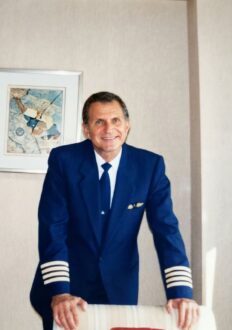
Michael Pacheco retired in 2001 at age 60, with 23,951 hours in his logbook 21,997 of them on Jet aircraft, across a fleet that included the Boeing 727, 707, and 747, the DC-3 and DC-9, the Grumman Goose, the Vickers Viscount, the Aero Commander, various Cessna models, the Piper Cub J3, the Chipmunk, and the Robinson R22 and Hughes 300 helicopters.
He survived dual engine failures over the Atlantic, an explosion seconds after takeoff from Los Angeles, and a five-year journey around the world by sea.
He became a Captain at 28, a pioneer in Jumbo Jet operations, and completed flight training with his favorite astronaut.
He blazed trails, sometimes literally, through the Guyanese wilderness by motorbike at night long before he ever climbed into a cockpit.
Michael Pacheco is more than a pioneering aviator. He is proof that a boy from Guyana, with enough curiosity, courage, and love of the sky, can leave his mark on every continent and ocean on earth. His story belongs not only to Guyana but to every young person who has ever looked up and dared to imagine what might be possible